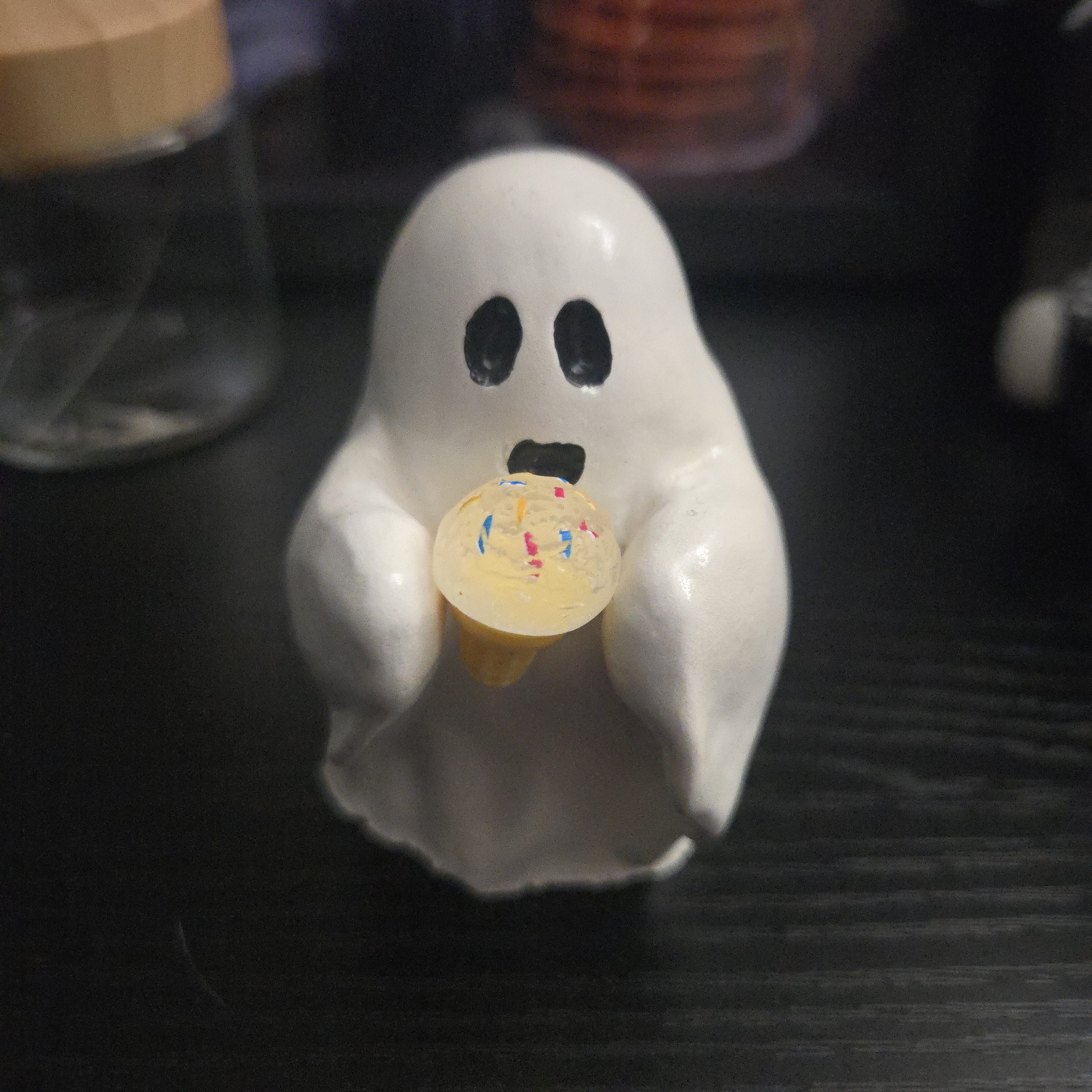
I was recently confronted with the question, “what is a ghost?” And it’s a good question. What is a ghost?
On the surface, I like to think I know a lot about ghosts. I just wrote a feature on one, after all. However, that ghost was a lot of things — some of which weren’t very ghost-like at all. Perhaps I know little about ghosts? Let’s see what I can say for certain about them:
- They’re known to appear at Christmas.
- You can find them in Luigi’s Mansions.
- They’re part of a nutritious breakfast.

Maybe I ought to turn to an expert.
“Ghostly experiences are neither supernatural nor unnatural; they fit into the general pattern of the universe we live in, although the majority of conventional scientists don’t yet understand what exactly ghosts are. Some do, however—those who have studied parapsychology have come to understand that human life does continue beyond what we commonly call death. Once in a while, there are extraordinary circumstances surrounding a death, and these exceptional circumstances create what we popularly call ghosts and haunted houses,” writes Hans Holzer in their book “Ghosts: true encounters with the world beyond.”
So, Holzer doesn’t quite tell us what a ghost is, but he gives us enough info to work back from — life and death.
Tell Me More About Life and Death
To answer what a ghost is, it might be easier to start by naming what it is not, and that is alive. And what is life? Depends on who you ask. Per Wikipedia, there are at least 123 different definitions of what life is:
“The definition of life has long been a challenge for scientists and philosophers. This is partially because life is a process, not a substance. This is complicated by a lack of knowledge of the characteristics of living entities, if any, that may have developed outside Earth. Philosophical definitions of life have also been put forward, with similar difficulties on how to distinguish living things from the non-living. Legal definitions of life have been debated, though these generally focus on the decision to declare a humandead, and the legal ramifications of this decision.”
So, turns out life is much like pornography — you know life when you see it because it’s not death. And what’s death? Not life. Easy! Next question.
What if you’re seeing something that looks alive but is dead? Well then, that’s a virus, which, depending on how you view it, either looks alive but is probably dead, or is probably alive but acts dead.
I know what you’re thinking, “Maybe viruses are ghosts or ghosts are viruses?” Good thought, but viruses aren’t conscious as far as we know, unlike Ghosts. Sometimes. Maybe. Depends on the ghost, really. Actually, the same goes for life, too, now that I think about it.

What’s consciousness? Too hard a question to answer.
However, we do know that conscious things do things — like live — and what do ghosts do? Per Holzer, they haunt.
So Then What’s a Haunting?
I’m Beginning to Think You Aren’t Taking This Seriously
No, I am. I’m deathly serious. I’m giving this my all — booing my best.
Your Inane Babbling Bores Me. I Came Here for Spooky Musings, Not Masturbatory Attempts at Humor
Oh. Okay. Gotcha. Real talk time then — what’s a ghost?
We have a strange relationship with fear. Take horror movies, for example. While wildly popular, they’ve been historically seen in the wider world of cinema as inelegant. Yet, the horror movie is the genre most capable of capturing the societal mood of a time. The specific worries and anxieties of a culture often get expressed via horror cinema. You can see this at play right now at the box office with the films “Obsession” and “Backrooms.”
“Obsession,” a film whose themes touch on the ‘male loneliness epidemic,’ incel culture and post-Gamergate gender war rhetoric, is a word-of-mouth success story. The film’s original streaming release date has been pulled as it continues to make money in theatres.
Then “Backrooms,” a film born of distilled liminality, has made A24 more money than even the most prescient studio accountant thought possible. Liminality has become something of a buzzword used as a shorthand for “scary place.” Though, as the larger Backrooms mythos highlights, it’s not fear of place so much as un-place. The uncanny feeling of being alone somewhere not designed for loneliness — shopping malls, office spaces and empty parks — and being there during that in-between time when no one else is around. It’s the fear of being the other in a place built for others.
Two horror movies making money hand over fist, touching on anxieties brooding in the culture for some time — loneliness, strained intimacy, change and the fear of it — and each made by a young filmmaker. Perfect examples of the genre reflecting society.
The movies are doing so well that they have some rethinking the horror genre’s malignment — a malignment that does make sense at face value, as it’s easier to treat our fears trivially than to confront them head-on. We have to go somewhere safe, the theatre, to engage with what worries us. In a way, it’s childish to run away into a supernatural fantasy as an adult rather than face our real-life fears, and perhaps that drives said malignment.

Like horror movies, ghosts are a maligned enigma that hold a strange place in the wider paranormal world. They’re easy to laugh at, with endless reality TV shows and online videos purporting to show the most easily debunkable evidence as proof of the supernatural. Watch any of these for long enough and you too will walk away with the notion that anyone who sincerely believes in ghosts is an idiot.
Yet belief in ghosts has existed throughout human history. There are stories of them being encountered across cultures and times. Perhaps that lends itself to their ridicule — humanity has believed in ghosts for so long, with no evidence, that the mockery comes naturally.
On the other hand, perhaps this persistence of belief is evidence of something. If horror movies are reflections of our current fears, then the ghost is a reflection of our most historic — death.
What happens when we die? No one knows and that’s, rightfully, scary. You are hurdling toward an unknown you can’t escape. The ghost as a reflection of that anxiety always lurking in the back of every human mind makes sense. It appears in our stories to remind us to cherish what we are one day bound to lose. Lampooning the ghost is a way of lampooning that fear, while also helping to support one’s own personal belief around death.
There is rightful criticism of people who believe in an afterlife and use that belief as a justification to act unduly in life. The sad logic of, “If there’s a paradise awaiting everyone, why act as stewards today?”
The materialist, rational crowd has a similar way of viewing the world — in that there is nothing after death. It’s like sleep or just total blackness, they argue. It’s a cold, nihilistic outlook saying, “Nothing matters in the end.”
Each group’s evidence for their belief is the lack of evidence they see for an alternative, but each holds essentially the same view. That in the end, what one does in life and what’s done to them won’t matter.
Enter the ghost with its challenge to both. If paradise or damnation waits after death, why is the ghost not there? And if there’s nothing after death, then there should be no ghosts at all. The beauty of this otherworldly monkey wrench is that it neither confirms nor denies any philosophy of the afterlife. All the ghost says is that something happens and it happened to it.
But then why are there so few ghosts compared to how many people die each day?
“Unfinished business” is the phrase that has become ubiquitous with hauntings. Haunted homes are filled with despair over a life cut short, and wraiths seek revenge for the injustices they faced in life. These are the tropes we associate with ghosts. The Greenbrier Ghost is a real-life example of them in action.
What makes a ghost is not death, but what happened to it in life that keeps it haunted, and thus, haunting.
And who among us isn’t already haunted in little ways?
- Our nervous systems are shaped by trauma and actions long forgotten by the conscious mind.
- Old memories linger in our heads, waiting to remerge at a certain smell or sound.
- We ruminate on “what if” scenarios and the directions our lives could have taken if we’d made one decision over the other, and stress over the impact of decisions ahead of us.

Much in the way horror movies are looked down on for being inelegant despite being a reflection of our real fears, the ghost is chided similarly. It must be engaged with at arm’s length because to confront the ghost head on would be to confront the true fear it represents — not just that we will one day face the true unknown of death, but that we might do so filled with regret.
So, what is a ghost? It’s the knowledge that life can be squandered.
I Change My Mind. Go Back to Being Silly
My favorite thing about ghosts are their BOObs.

Leave a Reply