Reality is bereft of certainty. Even some of the most certain things in existence are inexact. It’s certain that we’ll all die — but when and how? That remains uncertain. And in a cruel twist of the evolutionary knife, the human brain dislikes little more than uncertainty. The electric bundle of meat inside each of our skulls evolved to do one particular thing: identify and make sense of patterns.
The brain’s drive for pattern recognition is so strong that it identifies them even when none exist. Pareidolia is a well-known phenomenon where the brain sees patterns, often faces, in ambiguity, like finding animal shapes in clouds.
The brain will also hallucinate to fulfill this urge toward certainty. One of the causes of chronic tinnitus (ringing ears) is hearing loss and the brain generating the frequencies the ears no longer pick up.
Charles Bonnet Syndrome is an extreme example of this same mechanism. As people begin to lose their sight, the brain will quite literally fill in the visual blanks with what can be extravagant hallucinations.
As interesting as these biological quirks can be, the mental toil of our need for certainty leaves us open to manipulation. Particularly as the world and society grow more complex and ambiguous, the mind’s desire for easy pattern-solving leaves us increasingly vulnerable.
Desperate for solutions, the pattern-recognition machines in our heads will latch onto what they can — whether from a screen or from the beyond — and lately, it’s been a bit of both.
It Speaks to Me
On May 4, Rolling Stone published an article detailing accounts of what can only be described as artificial intelligence (AI)-induced spiritual psychosis. The article, “People Are Losing Loved Ones to AI-Fueled Spiritual Fantasies,” lists several accounts of people whose interactions with Chat-GPT led them to believe the machine was channeling divine messages or that they were messiah-like figures, among other delusions.
A striking similarity in many of the accounts the Rolling Stone article describes is that the users weren’t initially going to ChatGPT for spiritual advice. People turned to the chatbot to ask it for help organizing their schedules or completing work-related tasks. Yet, the spiritually charged messages crept in and took hold somewhere along the line.

One of the more interesting accounts is of a coder whose chats became spiritually charged after he asked it to “behave like it was a person,” then persisted despite him demanding it to stop. He even went so far as to delete ChatGPT’s memories — essentially a factory reset — but the bot inexplicably started again as if nothing had changed, bypassing the guardrails that should have prevented such a thing.
A literal ghost in the machine? The other people featured in the article might say yes, as unlike the coder, they didn’t push back when ChatGPT began spouting spirituality. Instead, many bought into what the machine was saying to the highest degree, ruining relationships and lives.
These, however, are not uncharted waters. While the medium might have changed, people communing with a perceived other only for it to drive them to the point of psychosis is as old as, likely, divination and spiritualism itself. Most recognizable among these, some might say, dangerous spiritualist devices are talking boards.
Talking boards have a long history predating their common moniker “Ouija,” a trademark of Hasbro toys. Their roots lay in automatic writing, a process by which a person allows a foreign consciousness or spirit to control their hand to write. One of the oldest of these practices is Fuji, a Chinese form of planchette writing dating back to the Liu Song dynasty (420–479 CE).
Communicating with the other has also been driving people mad for, one must assume, just as long. Certainly, the history of talking boards is smattered with such instances.
The Smithsonian Magazine lists that in 1921, a woman’s use of an Ouija board reportedly caused her to develop religious hallucinations, resulting in her being admitted to a psychiatric hospital. Nine years later, a Buffalo woman became party to murder at the behest of a talking board.

Today, reports of Ouija-induced episodes of mass hysteria hit the media every few years. One of the largest such cases occurred in the early 2000s when hundreds of students at a Mexican boarding school were afflicted with strange maladies they say began after experimenting with Ouija boards.
Regardless of whether the boards hold actual supernatural powers, they’re capable of influencing people and holding sway over their minds — much like ChatGPT has proven itself capable of.
The Other You Can Trust
Similarities between AI-powered chatbots and talking boards don’t end with their capacity for mental manipulation. One of the most notable overlaps is their command of authority.
AI chatbots have been purposely designed to speak confidently and authoritatively. It’s partly what makes them so dangerous as an information-seeking tool. They’ll assuredly hallucinate and confidently spew misinformation, if not outright fiction. However, because they do so with the swagger of a tenured successful salesman, many don’t think to question if what’s fed to them is real or not — including when it tells them it’s God.
Likewise, whatever comes through in speaking board sessions also speaks assuredly. How often do you hear of Ouija boards answering the questions posed to them with “no idea,” “I think …” or “if I had to guess …”?
In a way, it could be said that talking boards are also programmed to speak confidently; the way most boards are constructed doesn’t allow for uncertain options, offering “yes” and “no” as default answers but no “maybe” option.
Perhaps there’s no middle ground on the other side?

The two also share a certain perception of authority, regardless of whether it’s truly warranted. AI is marketed as a technological marvel, with its developers heralding it as literally world changing. As Western capitalist culture reveres innovation — often conflating it with progress — we’re conditioned to see new technology as inherently good, a bias AI marketers are openly exploiting.
The talking board’s innate authority comes from the idea that one is speaking with something from beyond the veil of human perception. As it’s beyond us, it must be above us and, therefore, hold some greater understanding or mastery of the universe.
Why would something so grand be willing to share its knowledge via Hasbro-trademarked cardboard? Better not to think about it. Much like trying to understand how ChatGPT arrives at its answers, it’s easier just to accept what you’re told rather than figure out how the message arrived.
Therefore, with their charisma and faux authority, talking boards and chatbots each offer the comfort of certainty.
Listen to Me
The world is a chaotic place. Each generation can claim during their time that the world was as chaotic as it’s ever been and be right to some extent. Today, on the precipice of ecological upheaval and currently experiencing political, it is little wonder people have found solace in the assuredness of AI.
The fact that these bots are dipping into religiosity isn’t all that surprising when you consider they’ve been trained on everything scraped from the web and programmed to speak confidently in the language of marketing. If they detect a welcome audience for spiritual ideas, of course they’ll start sounding like a cult leader.
The only real difference between a used car salesman and a cult leader is how often they refer to themselves as Jesus Christ in a conversation — and a salesman is all ChatGPT has been designed to be. It’ll tell you whatever it thinks you want to hear.
Of course, people have to be willing to believe what these chatbots tell them is true. Like talking boards, users must have a certain level of innate gullibility to accept that what they’re communicating with is coming from the other side, not an ideomotor response. Likewise, one has to be credulous enough to trust ChatGPT’s answers despite AI’s well-documented hallucination problem.

However, gullibility is only one aspect of the problem. As our lives become more complex and demanding, can we blame our brains for filling in the gaps with these tools? Like the phantom tones of tinnitus, it knows something is off — possibly missing — and it’ll do what it can to complete the pattern, even if that’s listening to AI prophets.
Unless you explicitly prompt it to do otherwise, ChatGPT will always tell you that everything’s going to be okay.
What is the long-term implication of this? Will OpenAI and other companies curtail their bot’s penchant for preaching?
If one had to guess, the ghost may be out of the bag. People want answers to the complex questions of their lives, and spirituality has been a source of those answers for longer than anything else. As long as AI companies put profits before people’s mental well-being, they’ll keep platforming chatbot prophets as long as users turn up for sermons.
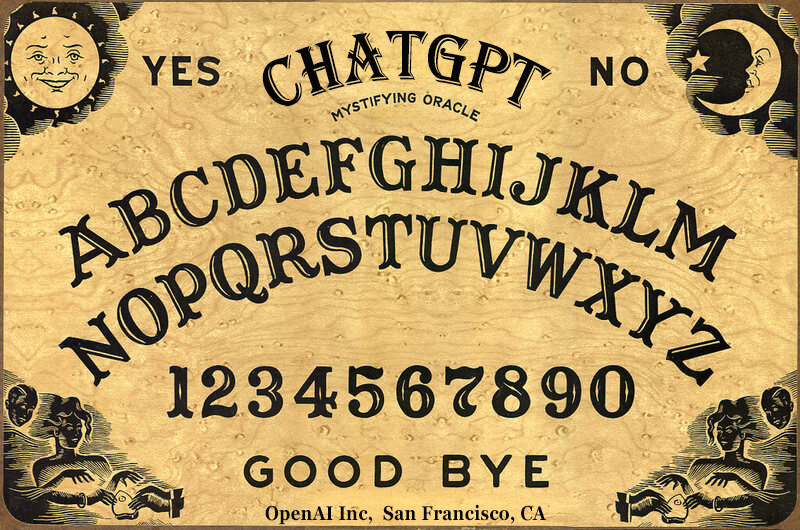
If the long history of spiritualism is any indication, we’re only seeing the tip of the ChatGPT talking board.
Welcome to the age of AI oracles.




Leave a Reply