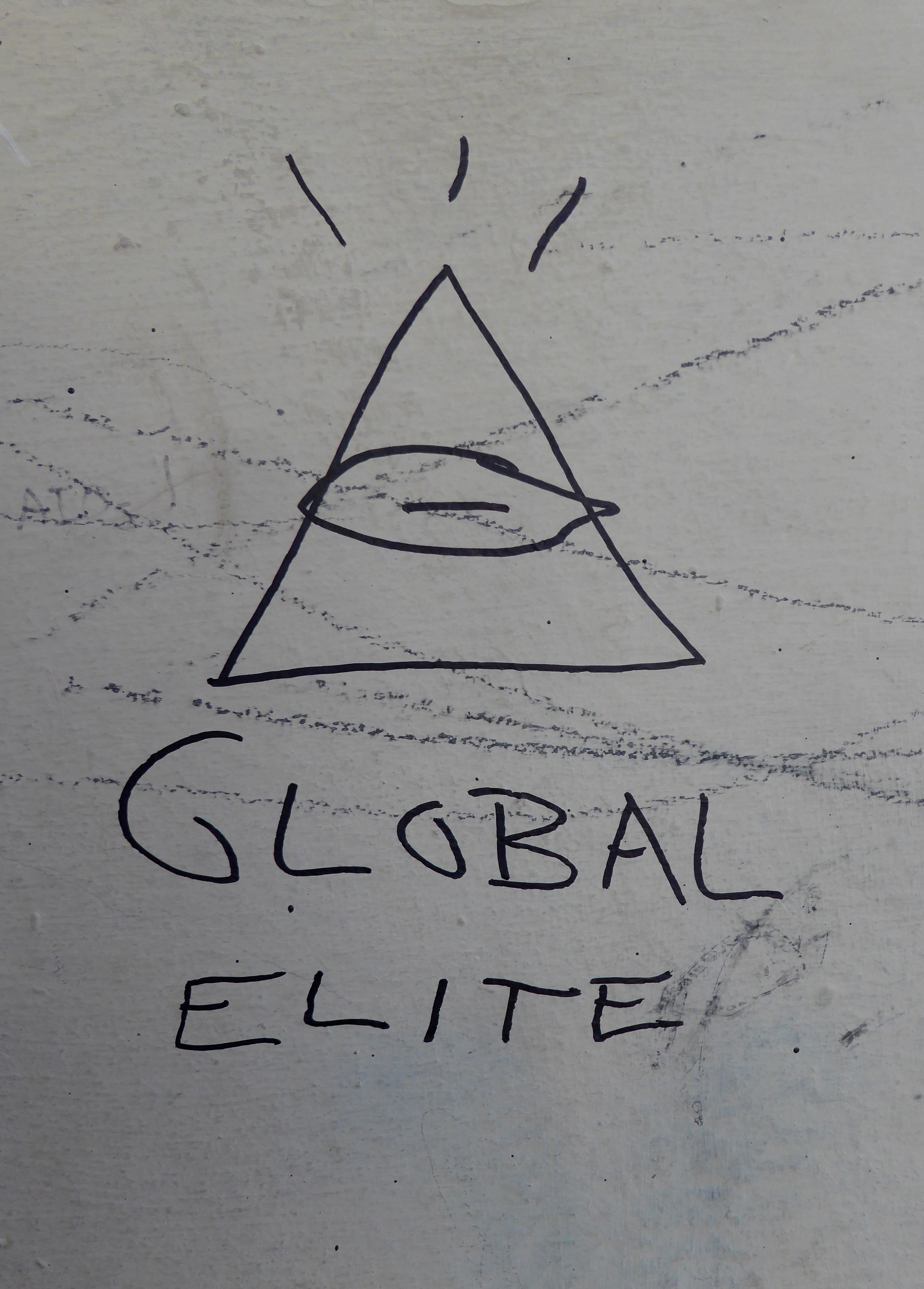
This past Wednesday was the 23rd anniversary of 9/11, and I received my annual flu and COVID booster shots. Naturally, the combo put conspiracy theories on my mind.
My interest in the paranormal has always put me in close proximity to conspiracy theories. I was born too late to be part of the, let’s call it, classical age of conspiracy theories. When pondering conspiracies was more about thinking critically on the narratives of the powerful and questioning one’s own biases, as SMiles Lewis describes here.
I was fortunate to pick up the mindset anyway. While my memory is too fuzzy to pinpoint when or how I have to assume it was by way of my father and JFK. I wouldn’t classify my father as a conspiracy theorist, but he certainly held misgivings with power; recounting his early childhood once, he told me his teacher wrote “has issues with authority” on his report card. Couple this with one of his earliest memories being JFK’s funeral processes, and you can connect the dots. I was in elementary school when I first saw the Zapruder film while watching some documentary with him.
Picking up that classic age conspiracy mentality has served me well. It’s kept me from ever falling down the crazy rabbit hole. I’ve been able to stay on the edge and peer in, saying to myself, “huh, wouldn’t that be something.” But as the world’s grown nuttier and nuttier over the last few years, I find myself at a loss for words when I peek into the rabbit hole now.
Undoubtedly, 9/11 kicked off the shift in conspiracy theories, but everything seemed to switch into overdrive around 2016. That’s when Pizzagate occurred, and not long after, QAnon appeared, positing a secret war between Trump and the deep state.
The QAnon stuff was fascinating to me, as I couldn’t grasp how anyone bought into it. I spent too much time during my teenage years on 4chan before it got its infamous reputation. Those wasted years had trained me to know anything with the suffix “anon” was not to be trusted. In fact, anything posted by an anon was to be taken as fiction until proven otherwise. Pics or it didn’t happen.
Yet, the quackery escaped the confines of 4chan and infected what were once reasonable people. I used to have a great friendship with a guy, then he straight-faced told me Joe Biden was a lizard person after he was elected and recently posted that Kamala Harris is secretly a prostitute. Now I get to play fact-checker anytime we hop on Xbox.

What drives people to ardently believe these kinds of outlandish ideas isn’t easy to quantify. Research published by Shauna Bowes, a doctoral student in clinical psychology at Emory University, showed there are often layers of nuance to people’s conspiratorial beliefs.
“Conspiracy theorists are not all likely to be simple-minded, mentally unwell folks – a portrait which is routinely painted in popular culture,” said Bowes. “Instead, many turn to conspiracy theories to fulfill deprived motivational needs and make sense of distress and impairment.”
Bowes’ research suggests that conspiracy theorists’ beliefs were motivated by a need to understand and feel safe in their environment, as well as feel like the community they identified with was superior to others.
Joseph E. Uscinski, a political science professor at the University of Miami, specializes in studying conspiracy theories and told the Skeptical Inquirer that conspiracy thinking exists on a continuum on which everyone falls somewhere. He adds that he’s been polling Americans since 2012 and that belief in conspiracy theories has remained consistent. What has changed is the tenor of conspiracy theories.
In an interview with Rolling Stone on QAnon, Uscinski offered the reporter a hypothetical choice between sitting with a JFK conspiracist and a Holocaust denier, with the reporter choosing the JFK conspiracist.
“So some conspiracy theories feel different precisely because they are different. And what we find is that some conspiracy theories – like Holocaust denial, saying that nobody died at Sandy Hook, things like that – they attract a different sort of person. And what we find on surveys is that those types of conspiracy theories, they appeal to people who have higher levels of psychopathy and narcissism. People who are sort of anti-social in their views, they’re picking out anti-social ideas to adopt. So it’s not the conspiracy theory doing things to them. These people are already different in their own way,” Uscinski explained.
He added that what he discovered through his analysis of QAnon is that it’s driven by people who hate the entire establishment.
What occurs to me reading Bowes and Uscinski’s research, coupled with my own conspiracy culture experiences, is that some of these post-2016 beliefs have to be driven by the fact that everything sucks.
I wrote this in April of 2021 in response to a PBS News article titled “Why COVID-19 Conspiracy Theories Persist”:
“The world today leaves people with very little control over their lives and many don’t understand how it’s happened. On top of that, our brains literally weren’t designed to handle the kinds of stressors we face today. The pandemic compounds it all. Conspiracy theories help restore a sense of both control and understanding to the individuals who follow them. It’s why conspiracy theorists can become so hostile and/or denialistic when challenged. You’re not just challenging their idea that the Earth is flat or COVID-19 is a hoax, but their sense of how the world operates and where they fit in.”

My friend isn’t a psychopath; he’s poor. He’s lived in the same town his entire life, can’t afford to see a doctor for his body or mind, and is trying to raise his son as a single parent. He’s a person trying to navigate a world that gets more expensive and oppressive every year.
He also lacks the education needed for him to fully grasp and articulate the multitude of economic forces and monied interests that have had a hand in it. We’ve had long conversations where he agrees with socialized healthcare and how much that would help him. The caveat is I never say the scary socialism word during those conversations, as he doesn’t agree with any of “that.” But strip out the dog whistle words, and you’d mistake him for a comrade because of the way he sometimes talks.
So, tell him Joe Biden is a lizard person who’s out to screw over hard-working folk like him, and that’s easy for him to get. Trying to explain class consciousness and the forces of late-stage capitalism over burgers and beers isn’t as concise.
I don’t think it’s a coincidence that it’s in 2016 that we saw conspiracy theories shift the way they did. It was the end of the Obama era, and the hope and change message he campaigned on in 2008 hadn’t come to pass for many.
Published in 2016, American political analyst and author Thomas Frank’s book, “Listen, Liberal: Or, What Ever Happened to the Party of the People?” details how the Democratic Party shifted from its blue-collar roots to serving white-collar interests to its and the population’s detriment.
In 2017, with Trump in the White House, the book was republished with a new afterword by Frank, who pretty much says, “I told you so.”
“So, we bounce on, from government by one group of affluent people to government by a different group of affluent people,” Frank writes. “Consensus-minded centrism yields to authoritarianism, which will self-destruct in time and allow the consensus-minded another chance, which they will inevitably fumble, and so on. When will it all end? When the People finally come back for their Party.”

It’s easier to understand the world in conspiratorial terms rather than whiteboarding how one economic or political decision in the 90s snowballed to a person’s job closing down today.
As Uscinski noted, these beliefs can attract psychopaths and other naturally unsavory individuals, and there’s no excusing the violence, racism, and other deplorable beliefs and actions that some conspiracy theorists engage in.
However, as Bowes’ research suggests, others in these conspiracy circles are there to feel safe and make sense of distressful times. It’s not a leap to suggest that if we had a more accommodating and protective society – one where, for example, 59% of people didn’t have to worry about their emergency savings and more than just 51% of people could afford a $1,000 unexpected expense – maybe people would act more rationally.
People grasp for answers when life feels unmanageable. Unless they have the ability to reason out the next best course of action, they can fall susceptible to all manner of perceived easy ways out, of which conspiracy theories are just one avenue. Losing that ability is also startlingly easy. As Uscinski said, we all already exist somewhere on the conspiracy continuum.
We might be able to act rationally and think critically today, but if you lost your job and were staring down a $1,500 root canal and a partially full fridge, how long could you hold onto the ability to stay centered? How long could you go with your mouth throbbing and stomach growling before you started sliding on that continuum?
It doesn’t take a formal conspiracy to explain why desperate people believe desperate things.

Leave a Reply