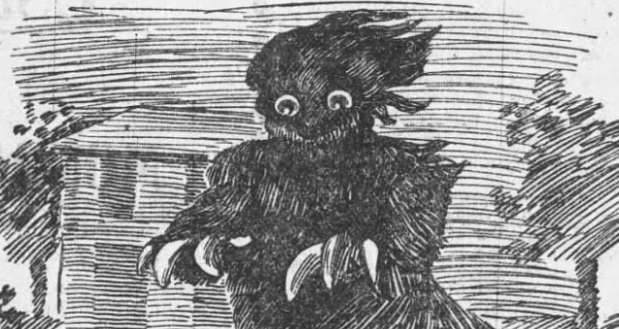
Forty-five years ago today, the Mineral Point Vampire was first seen, kicking off a modern local legend. But what if I were to tell you that it wasn’t a vampire seen all those years ago but a ghost — The Ridgeway Ghost.
Terrorizing the Ridgeway region from the 1840s onward, the Ghost took many shapes and guises, never content to repeat the same prank too often. From vanishing vagrants to fireballs, ghoulish livestock and more, the transitory nature of the Ghost was part of its haunting tactics.
Anything a bit odd or unusual encountered — such as a leaping graveyard ghoul — could be a prank of the otherworldly character.
“He was the most exacerbating of phantoms, the practical joker, and one who shamelessly exploited his obvious advantage, played according to no rules whatever, and generally turned out to be a downright nuisance,” Robert E. Gard and L.G. Sorden wrote in their book “Wisconsin Lore.”
Common wisdom says the Ghost left the area sometime in the late 1800s or early 1900s, but there’s good reason to suspect the Ghost never leaves its adopted home for long, if at all.
UFOs and other oddities might well be the Ghost still at play today, if you believe in such things as many people did when the Ghost and its stories first took form some 180 years ago.
The Roots of The Phantom
The Ridgeway Ghost was at its height during Wisconsin’s pioneer days, chiefly the 1840s and 50s, when lead deposits attracted miners to the region. As Michael Norman details in his book Haunted Wisconsin:
“The opening of the mines attracted rowdy, tough, dangerous men whose job it was to wrench the lead from the earth’s grasp. From Ireland, Wales, and Cornwall, and from Germany and the American South, miners came to the lead district surrounding the pioneer outposts of Mineral Point, Dodgeville, Blue Mounds, and other small villages. At the height of the mining boom, nearly forty thousand pounds of lead would be hauled each year to markets in Milwaukee, Dubuque, Chicago, and Galena.”
To transport the valuable minerals from mine to market, the Old Military Road was utilized that connected Dodgeville to Milwaukee. In the middle of the road between Dodgeville and Blue Mounds, then known as Pokerville, sat Ridgeway.

Today, remnants of this road remain as a State Trail, but in the 1840s and 50s, it was a much rougher route, dotted with saloons and requiring ox-drawn wagons to navigate.
“There were no were no fewer than ten to a dozen saloons, most of them with an reputation, and frequented by toughs, gamblers and miners,” Wisconsin folklorist Charles E. Brown wrote in his 1943 pamphlet “The Ridgeway Ghost: Stories of this famous phantom of the Old Military Road.”
“In these taverns fights between drunks and others were of frequent occurrence and robberies and murders were committed.”
It is from these seedy saloons that today’s most commonly told tale of the Ghost’s origins springs. The author remembers it told to them as follows:
One night, in the early days of the settlement known as Ridgeway, a blizzard unlike any other struck. The local saloon — one of the few safe spots for miles — was packed with weary travelers and thirsty locals taking refuge from the icy winds and mounting snow.
Near the fireplace at the back of the saloon, a poker game was in progress, with what at first glance you might assume was a bear in the seat nearest the flames. And in some ways, you’d be right, for the man was not only the size of a grizzly but had a temper like one, too.
Eventually, the man’s drinks caught up with him and he left to relieve himself, leaving his warm seat open for any of the other patrons to take. Of course, none dared.
It had only been a moment since the man left the room when two young brothers walked in from the cold. The younger brother went to get them a drink, while the other went to warm himself by the fire. Noticing the empty seat at the table, he asked if he could sit.
Perhaps as a prank or maybe just out of malice, the men at the table smiled and welcomed him.
The chill had barely left the boy when a roar came from beside him. “That’s my seat,” bellowed the man, who lifted the boy to his feet and began beating him.
Hearing the commotion, the younger brother turned from the bar to see his brother taking blow after blow from the beast of a man, and he did what any brother would do — he ran to help. But by the time he made it, his brother was unconscious and so bloodied as to be barely recognizable, staying upright only by the grip the man had on him.
“Let him go,” the younger brother shouted as he charged the man.
Without a word, the man turned to the boy, lifted him off his feet and threw him into the fireplace. As his screams filled the saloon, no one came to the boy’s aid, fearing what the man might do to them if they did.
Somehow, by a combination of pain and panic, the boy pulled himself from the fire. Still aflame, he ran out of the saloon and into the night.
Hearing his brother’s cries, the older boy came just in time to see his younger brother fleeing into the blizzard, and with what strength he still had, followed after him.
In the morning, some men went to look for the two. They found faint footprints in the snow leading to the river, but neither brother was ever found.
But ever since that night, the area has been haunted — the souls of the brothers acting in tandem to have their revenge as The Ridgeway Ghost.
It’s a gruesome tale, and you’ll hear shades of it told today in different ways, but the central premise of a young man or two meeting their end in a saloon as the source of the Ghost remains consistent across retellings.
However, Brown writes that it wasn’t a murder at one of the taverns that manifested the Ghost, but rather it was conjured to run wrongdoers out of the area by playing on their superstitions:
“It is thought that this specter was originally created by some wag or wags to help rid the region of the disreputable element which hung out at the saloons. Practical jokers helped to spread the growing popular belief in the Ghost whose presence and pranks soon became more or less feared by nearly everyone.”
The Places Ghosts Call Home
There is a third line of thinking that the Ghost is a traveling phantom, splitting its time between the new and old worlds.
“It was 195 years ago or better when the spirit crossed the ocean to the ‘land of the free and home of the brave.’ Searching adventure and a better life, just like his companions sailing with him, who were lured to America by rich mining. The spooky and not-to-be-forgotten ghost journeys back for reasons unknown,” Jeanie Lewis wrote in her 2022 book “Ridgeway Ghost: Wisconsin’s Most Famous Spook.”
Lewis’ notion that the Ghost travels back and forth to its home abroad aligns with the commonly held belief that every 40 years, there is a spike in spookery around the Ridgeway region.
Of course, if Ridgeway is the Ghost’s home away from home, it would need a place to call its own — and as it turns out, the Ghost had a house.
“… The Ridgeway ghost found a house some distance east of Ridgeway, which it is said some settler had abandoned when his well went dry. It is said that some railroad section men sought shelter in this house during a terrific storm and while there had a section of the ceiling plaster fall upon their heads,” wrote Albert O. Barton in his article “The Ridgeway Ghost,” published in the July 1923 edition of The Wisconsin Magazine. “This occurrence was attributed to a malevolent prank on the part of the supposed shadowy tenant of the building and confirmed its existence in the minds of many when they learned of it.”

An unnamed author penned the article “In the Haunts of The Ridgeway Ghost” for the January 27, 1904, edition of the Wisconsin State Journal and gives the following description of the house. Passing by it on train, they write:
“In a moment we shot past the house, a gray, one-and-a-half-story frame structure, warped and weather beaten, with spectral-looking windows. The house, however, is not now on its original foundation. The owner some years ago, vexed at the reputation it had acquired, if for no other reason, had a gang of men pull it down at noon one day, when the Ghost could not walk, and rebuilt it some ten rods from the original site. Whether this has broken the ghostly spell hanging over it or not remains for time to prove.”
The author later adds that the home was originally occupied by a “queer mysterious hermit” who had suddenly disappeared twenty-five years prior, and that ghostly activity began shortly thereafter.
And I suspect by now you’re wondering just what that otherworldly activity entailed. Well, if you thought the Ghost with three different back stories that owns a dilapidated home wasn’t weird enough, imagine what it did for fun.
The Ridgeway Shapeshifter
The Ghost is often written about in the masculine, but it is as likely to appear as a young woman as it was a headless horseman, a hog, a fireball or levitating poker cards. The only consistent quality of the Ghost was its inconsistency, which helped set the phantom apart from its contemporaries.
“If there had not been some things about the Ridgeway ghost that are hard to explain it might as well not have been. Had it not differed from the ordinary Virginia ‘hant,’ for instance, it had hardly been worthwhile, and certainly it would not have achieved the publicity it attained,” Barton wrote.
Indeed, the Ghost’s antics broke through to the mainstream in 1902 with the New York Times article “Some Wisconsin Ghosts,” which recounts one Dr. Culter’s run-in with the phantom.
“One night as the doctor was driving homeward after a visit to a patient in the country, he was suddenly affrighted at seeing a dark figure seated on the pole between the horses. The reins slipped from his nerveless hands and the horses dashed away at full speed, the specter riding the pole nothing discommoded by the shaking he was getting. Up and hill and down another, and lo! The specter vanished.”
Apparently somewhat of a drunk, Dr. Cutler’s story found few believers. However, he asserted he’d been sober at the time, but admitted to having another encounter with the Ghost a year prior when a bit more pickled.
“While passing the selfsame haunted spot, he had become aware of a dark and silent stranger sitting beside him int eh carriage. For a mile the stranger rode without saying a word, and all at once he was gone. At the time the doctor had asked no question of his drunken wits and had considered it a strange experience and nothing more.”

These strange but mostly harmless pranks were the style of many of the phantom’s tricks. One of its preferred ruses was to appear as a woman wandering alone in the road, as Norman writes:
“An unidentified man was driving his team of horses near Ridgeway when he sighted a woman directly ahead. She was going in his direction, but walking down the center of the road. He yelled at her to move but she didn’t respond or turn around. The horseman moved over to pass, but as he did so the mysterious woman moved to the side to block his approach. He urged his team into a faster gallop to get around her, but the woman always somehow managed to stay ahead. He halted his team — and she halted too. When he started again, she did likewise. After several miles of this frustrating exchange the woman vanished.”
Norman notes that the Ghost sometimes appeared as an older woman who vanished into a fireball when people approached her.
Aside from fireballs, the Ghost would often bathe itself in a great light to frighten folk, such as in this story printed in the November 7, 1895, edition of the Mineral Point Weekly Tribune detailing Sheriff Carrow and A.L. Robbins’ encounter with the wraith:
“The Sheriff and Mr. Robbins tell … that the ghost appeared ‘as a great light before them, had the appearance of a human being and muttered something to itself as they passed by, that their team became greatly frightened and came near overturning their buggy and running into the wire fence and thereafter became uncontrollable, so that they ran for a distance away from this strange appearance.’”
The Ghost was said to appear most often to skeptics and had a sardonic sense of humor at times, showcased well in this short tale from the June 1942 issue of the Hoosier Folklore Bulletin:
“The man had been drinking at a tavern and was followed by the Ghost. When the man was out of breath from hard running, he sat down on a log. The Ghost came along and sat down beside him. The Ghost said, “That was a damn hard run we had?” “Yes,” said the man, still breathing hard, “and as soon as I catch my breath, I’m going to run some more.”
Of course, it wasn’t always just fun and games. Occasionally the Ghost dabbled in more macabre frights, as Brown recorded:
“Johnnie Owens was walking toward Ridgeway one night and singing some Welsh songs to keep up his spirits. As he approached a big roadside tree he saw three dark ‘somethings’ hanging from a limb. They were swaying in the moonlight. When he came nearer he saw that they were human bodies hanging by their necks. That was just too much for Johnnie, he ran all the way to Ridgeway. The next morning, with several friends, he returned to the tree but no bodies hung there.”
Then some accounts mixed humor with horror, such as this story of haunted swine from “Wisconsin Lore”:
“Old Mr. Lewis was returning home one evening from a farm where he had been doing some butchering. As he trudged homeward along the Ridge Road he noted the presence of a sow and some young pigs in the road just ahead of him. They were moving up the road very slowly. Every time he looked at them the pigs and the sow grew in size. As he drew near they were already as large as the cows. They were growing larger and larger. He struck at them savagely with his butcher knife. At this they disappeared from sight, vanishing in the air. He now knew that these were ghost swine, and that they were the brood of the Ridgeway Ghost. The old man reached home, but his experience was too much for him, and he sickened and died soon thereafter as a result of his fright.”
Oh yeah — the Ghost kills people sometimes.
The Ridgeway Wraith
The Ghost’s antics have caused the death of three people, according to sources. Who are these three people? It’s hard to say. The March 20, 1900, issue of The Evening Telegram says Dr. Cutler met his end by way of the Ghost, as well as a local dressmaker.
However, Brown also has the following deathly account in his pamphlet:
“In 1933, Louis Meuer, the sexton of the Catholic Cemetery at Ridgeway did not return home at night. The next day his body was found hanging in a tool shed. For a year he had been In poor health. Afterward there was some whispered talk that Meuer had probably had some disagreement with the Ridgeway Ghost and the Ghost had hanged him.”
That gives us several supposed dead by the Ghost’s hand, but there’s only one that’s verifiable — or at least consistently retold — and that’s Old Mr. Lewis. Sort of.
John Lewis, father of world wrestling champion Evan Lewis, is the man most often cited as having met his fate by the Ghost.
Lewis was described as “a man of sober life, of undaunted courage, and blessed with tremendous psychical strength,” in the article “Killed by Specter,” published in the April 12, 1900, edition of the Beloit Daily News.
Lewis encountered the Ghost in 1884 while returning home from spending the day assisting his friend with butchering. Night had fallen and the path Lewis was taking to get home took him past one of the Ghost’s known haunting spots. Intending to take a shortcut home, Lewis was hopping a stone wall when he first noticed something unusual:
“His attention was arrested by the sight of a figure that seemed to have gathered itself together out of the just now tenantless air, and stood confronting him in a menacing attitude.”
Lewis figured it must be someone trying to pull a prank on him, so he shouted at them. Receiving no response, Lewis advanced on the figure.

“The figure did not budge, but stood a towering shape of blackness, a gigantic and grisly thing. Some unaccountable awe and uncanny hugeness of the thing made Lewis decide to avoid a conflict, and drawing his butcher knife from his pocket, he started to pass by, when the figure, raising an arm with forbidding gesture stepped athwart his path.”
Now thoroughly terrified and seeing no other option but to fight, Lewis plunged his knife into the figure, but it pierced only air.
In the morning, a neighbor found Lewis lying by the stone wall, semi-conscious. He couldn’t remember much of what happened after striking at the figure, but said he had been hurled in the air as if in the vortex of a cyclone, “pounded, beaten, crushed into insensibility. Beyond the awful pain and the awful fear, he remembered nothing with distinctness.”
As Lewis lay dying, he asserted that it was something supernatural that had attacked him. He died a few hours later after being carried home, “his neighbor having it that his heart had been literally torn to pieces with shock.”
Thankfully, today the folks of Ridgeway travel the roads safe from otherworldly assailants, as it’s believed the Ghost departed the area when the Chicago & Northwestern Railroad line was built to Mineral Point.
“It was said that the Ghost left because he could not stand the whistle and puffing of the railroad engines and the rattling over the rails of the trains of freight and passenger cars. However, the Ghost was reported to have once been seen seated on the cowcatcher of a railroad engine as it was leaving Ridgeway,” Brown wrote.
But some think the Ghost makes regular returns to the Ridgeway region, while others think it never left at all.
Gone but not forgotten, or forgotten but not gone?
The Driftless Area of southwest Wisconsin is a hotbed of odd activity. That the Ghost would find a home there isn’t at all surprising. If it hadn’t fallen out of memory, many of the oddities associated with its stomping grounds would still today be attributed to it. The most famous contemporary legend from the area, the Mineral Point Vampire, is a perfect example of a modern Ridgeway Ghost prank.
And while scarce, there are those in the region who still see the Ghost at work today.
Set against the backdrop of the early days of the COVID-19 pandemic, Jeanie Lewis’ “Ridgeway Ghost: Wisconsin’s Most Famous Spook” — written with help from local historians Melva Phillips, Margaret Disrud and Bev Hoernke — opens anecdotally with the women detailing what one could call a localized UFO flap they attributed to the Ghost.
Roy Farwell, cited in the book as a local ghost storyteller, speculated that the Ghost left Ridgeway in the 1970s to make flying saucers and that he’d return one day with them. If the stories told in “Ridgeway Ghost” are to be believed, Farwell may have been onto something.
What’s commonly seen in the book is described as a bright star:
“It sticks out in the night sky. Then, taking a longer look, you see the action, as it goes through various shapes and motions. The lights seem like small Christmas tree types if several colors. When zooming in with binoculars, the ‘big star’ becomes a blue basketball or moon shaped object. It closes up, like it doesn’t want anyone to see what’s going on. Sometimes it is a small oblong ‘thing’ jumping and sometimes dancing a jig or patty-caking as it goes upward. One night close to daylight, spews of something pinkish is sighted than disappears,” Lewis wrote.

As we’ve noted in other essays, the Driftless Area has a higher than usual concentration of UFO reports compared to its population density, and the National UFO Reporting Center (NUFORC) has the following two reports from near the Ridgeway Ghost’s area:
2013: “An orange light in the sky appearing in the southern sky. Very bright. slow at first, then accelerating across the sky to the North. Looked like a forked tail after a bit….before flickering and disappearing. Definitely not an airplane. Not blinking at all. Kind of seemed like a rocket or missile that eventually ran out of propulsion.”
2017: “I was driving towards Ridgeway, WI, and on the left side of me off the highway, I saw a very bright light. The object didn’t appear to move and there were airplanes in the sky at the time. I was playing loud music and the object seemed to come towards me very slow. I slowed the car down and looked up as it flew over me and I saw a triangle shaped object. I look in my rear view mirror and it was gone.”
Aside from UFOs, the area has a handful of Bigfoot reports, as well.
Of course, UFOs, vampires and sasquatch are all well and good, but the Ghost still keeps some of its tricks from the 1800s in play, too. Dennis A. Wilson, writing a Halloween-themed entry for his blog “History and Politics,” shares this odd experience he had while traveling the Ghost’s home turf in 1981:
“As I drove along highway 151, my headlights illuminating the flakes of light snow that blew at me and flew by into the blackness, I could hear my wife beside me gently talking to the baby that she rocked in her arms to stop her crying. Our visitor slept in the back seat.
From nowhere a thin man dressed in ragged pants and an open shirt that waved in the wind appeared on my right, from the edge of the highway. His arms raised and flailing he ran right in front of me and disappeared into the darkness on my left.
‘Did you see that!’ I shouted.
‘What?” my wife replied, raising her head from the child and looking at me.
‘A guy just ran in front of me’ I replied, ‘He must be crazy being out here in the freezing cold with only a shirt and undershirt on!’
She asked me what he looked like. Strangely enough, I could not remember his face, only the tattered shirt blown wildly by the wind and the arms above his head flapping as he dashed by. I drove home and remarked upon it to friends who were totally agreed that whoever he was, he must have been very drunk. Later I learned about the Ridgeway Ghost. I wondered, as I still do who or what I encountered that night.”
So maybe the Ghost hasn’t left entirely. Perhaps it’s indeed a traveling phantom, or given its shapeshifting ways, has kept up with the times, transfiguring into different forms as the local beliefs and customs changed.
Traveling the roads of Ridgeway today might be the only way for you to find out for certain if the phantom does indeed still linger in one form or another. If you choose to find out for yourself, just be prepared for a scare; keep your butcher knife close and your eyes alert for odd lights in the sky or hulking shadows at the roadside.
The Ridgeway Ghost — that transitory phantom — could be anything or anyone you meet in your travels, just waiting to make you its next mark.
![[Unlocked] Exploring “The Goblin Universe,” a Paranormal Classic That Holds Up](https://driftlesstimesmedia.com/wp-content/uploads/2025/08/cover-cropped.png)
Leave a Reply