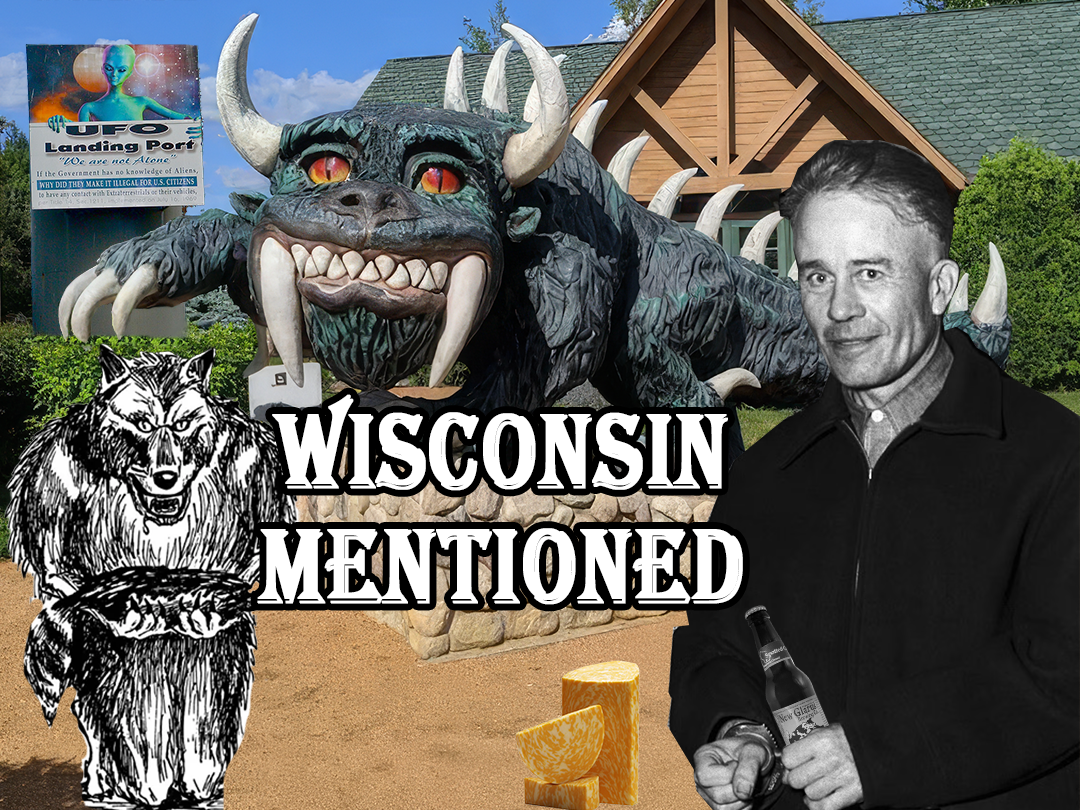
From true crime thrills to supernatural chills, the badger state is home to a seemingly endless variety of high strangeness — and people are beginning to take notice.
I’ve been enjoying the “Hi, Strangeness” podcast hosted by Steve Berg. While not a Wisconsinite, Berg has taken notice and expressed a great fondness for weird Wisconsin. He has featured a handful of Wisconsin folklorists and researchers and often asks them, “What makes Wisconsin so strange?”
If I were a serious self-promoter, I might write in to say I have the answer, but since I have an “if you build it” mentality, I’ll lay it out for you all right here for free.
So, why is Wisconsin so weird?
Layers of Liminality
The association between liminality and the paranormal has become a well-recognized element in recent years. George P. Hansen’s book “The Trickster and the Paranormal” helped popularize this link, but the idea itself dates back as far as storytelling, evidenced by the trickster archetype.
For readers unfamiliar with the concept, the idea is that people are more likely to experience paranormal events during liminal and transitionary times. A classic example is when people move into or renovate a home and experience what is usually classified as haunting phenomena.
Additionally, some places and times straddle thresholds. The hours of twilight are a natural liminal period, bridging the transition from day to night.
Wisconsin has two distinct liminal features. Geologically, the state is home to the Driftless Region. While the region also extends into Iowa, Minnesota and a small part of Illinois, the majority of the Driftless is located in Wisconsin — and it is unlike anywhere else in the area.

When the glaciers came down from Canada, crushing the land before them flat during the last ice age, they sidestepped the Driftless. No one knows why. It resulted in most of western Wisconsin being covered in great hills and bluffs more akin to the Appalachians than the farmlands and forests of the rest of the state.
Then, splitting Wisconsin in half is the Tension Zone — a literal transitional area where the northern climate and ecology of the state meet the southern.
Per the University of Wisconsin–Madison, “Wisconsin’s tension zone marks the crossover between the Northern Mixed Forest — closely related to the forests of northeastern Minnesota, northern Michigan, southern Ontario, and New England — and the Southern Broadleaf Forest, which is more like forests you’d see in Ohio and Indiana. In the tension zone you’ll find plants and animals representing both of these forest types.”
Between the Tension Zone and the Driftless Region, Wisconsin is bisected vertically and horizontally by the forces of nature. That’s a lot of border areas — a lot of liminality.
For example, Wisconsin has three UFO capitals: Dundee, Belleville and, most infamously, Elmwood — the latter of which often contends for UFO capital of the world. Elmwood is located at the northern edge of the Driftless Region and Belleville is situated at the southern edge. Dundee sits at the eastern edge of the Tension Zone.
However, it’s not just nature that makes our state uniquely betwixt.
A Traumatic Past
In my article “A Land of the Dead,” I wrote about the state’s traumatic ecological past — how its forests were clear-cut and the land torn apart for farming and mining operations — and why this might be the reason Wisconsin is said to have more ghosts than any other state in the nation.
Trauma is itself a kind of liminality, a wound that remains raw long after its infliction and unable to fully heal, persisting like a ghost. If, as I lay out in “A Land of the Dead,” Wisconsin’s ground is traumatized by all the pioneers and settlers put it through, then it only makes sense for it to be equally haunted.
I’ve written a lot about the Mineral Point Vampire, as it’s one of Wisconsin’s more unusual cases. Long before it became home to a vampire, however, Mineral Point was a thriving mining community.

The historic site of Pendarvis is a group of 19th-century stone and timber cabins built by Cornish immigrants who came to Mineral Point for lead and zinc mining. They did so despite the land not being open to white settlement, which violated the treaty rights of the native nations settled there, according to the Wisconsin Historical Society.
Notably, Pendarvis’ remnants were saved by Robert Neal and Edgar Hellum — two gay men who shared an interest in the site and forged both a working and personal relationship. Hansen notes that people on the margins of society — such as two gay men in the 1930s — are also attractors of odd phenomenon.
Therefore, to tally it all up, we have a community founded on disturbed earth and broken treaties, whose original remnants were preserved by two men on the outskirts of their societal times. How could a place like Mineral Point not be home to something supernatural?
And it’s far from the only spot like it in Wisconsin.
Memories of Ancient History
Wisconsin’s indigenous roots run deep. Wisconsin has some of the highest concentrations of indigenous effigy and burial mounds anywhere in the United States — particularly around the Dane County and Madison area.
A short drive outside of Madison is Aztalan State Park, a National Historic Landmark that features the remnants of an ancient Middle Mississippian village dating back to between A.D. 1000 and 1300. Its people built large, flat-topped pyramidal mounds, which can still be seen, along with reconstructions of structures that have otherwise been lost to time.
The exact identity of the builders of Wisconsin’s mounds is unknown. When settlers arrived in the area, the local people provided vague responses regarding who had constructed the effigy mounds. While it was undoubtedly the ancestors of Wisconsin’s native people, this has left the door open for white supremacists and other cranks to try and claim the history for themselves.

Moronically, for example, Aztalan got its name from settlers who mistakenly thought the ancient site was related to the Aztecs of Mexico because they thought the structures looked similar to ones found there, which has fueled all manner of pseudo-archeological ideas, some disturbingly promoted by literal Nazis.
Aztalan is also said to be quite supernaturally charged, and many other areas around effigy mound sites are home to great legends and folklore.
Such is the case of Lake Mendota, which is dotted with numerous effigy mounds — some of the largest of anywhere in the state. The lake also has a great deal of indigenous folklore associated with it, such as being home to angry water spirits. In more modern times, people have claimed to have encountered a sea serpent named Bozho, UFOs and even Bigfoot around Mendota’s waters.
The forgotten and co-opted history of places once regarded by its people as significant, if not sacred, not to mention the trauma of the people forced off those lands? It all sounds mighty marginal to me.
The Betwixt Badger State
Anywhere you step in Wisconsin is betwixt and between something, be it geology, ecology or history. It may only make sense that we find so many creatures and inhabitants of the other side coming out from between these cracks.
I began penning this piece on June 1, 2025. On June 4, the great Wisconsin researcher Chad Lewis appeared on the “Binnall of America” podcast. When asked what makes Wisconsin so strange, Lewis offered a similar response about Wisconsin’s unique terrain as detailed above — listen to it here.
Lewis also noted that he finds Wisconsinites more open to discussing these subjects, something I’ve also noticed. Growing up, everyone I knew was interested in the paranormal to some degree. Even today, I’m not sure of anyone I know who I would classify as an ardent skeptic. We’re all weird in Wisconsin.

Perhaps this lends credence to the effects of the state’s liminal natural and historical features — the oddities are so pervasive that they’ve infiltrated their inhabitants’ very blood. There’s also something to be said about the state’s drinking culture because what is drunkenness if not liminality imbibed? Though that’s an essay for another time.
So, why is Wisconsin so strange? It may just be that we are.
Wisconsin is so steeped in strangeness that the unusual is usual around here. To remove the strangeness would be to remove the Driftless Region, the Tension Zone and the unknow mysteries of the lands we live and work on.
Wisconsin is strange because if it weren’t, that would be strange.
![[Unlocked] Exploring “The Goblin Universe,” a Paranormal Classic That Holds Up](https://driftlesstimesmedia.com/wp-content/uploads/2025/08/cover-cropped.png)

Leave a Reply