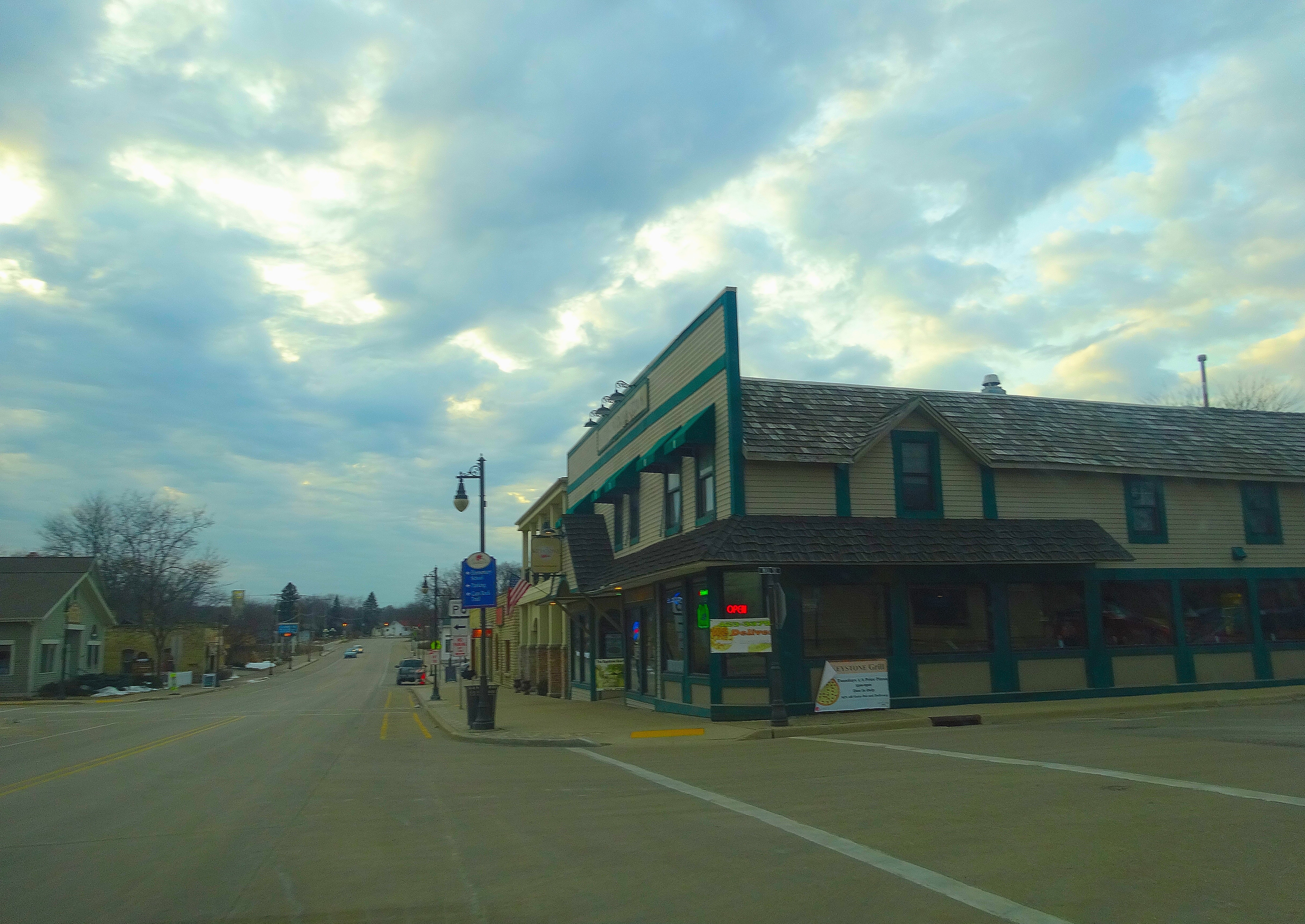
Cover image is of downtown Cambridge, Wisconsin. Credit: Corey Coyle.
In 2015, something strange started happening: Google began autocorrecting searches to a town called Doveland, Wisconsin — a place that has never officially existed. People with vague memories of the town and those who purport to have found evidence for it say it was real but disappeared into thin air sometime in the late 1980s or early 90s — residents and all.
Since Google first began suggesting it, the legend of Doveland has steadily grown. In recent years, the popularity of the town and its mythical disappearance has exploded thanks to various YouTubers and podcasters covering the topic.
Was Doveland real, and if so, what caused its disappearance? Military cover-up? Natural Disaster? Something more supernatural?
Let’s find out.
Doveland? Never Heard of It
As the legend goes, Doveland was a small town located somewhere in northern Wisconsin. Some stories place it near Green Bay. It was a normal, unassuming rural Wisconsin town until it quite literally disappeared one day.
If you were born before 1990, then it’s said you may have a faint memory of Doveland, as some Wisconsinites reportedly do. Some say they remember picking up a radio station out of Doveland, even after it had disappeared.
Outside of people’s scant memories of it, evidence of Doveland’s existence can be found in souvenirs and merchandise bearing the town’s name and, most notorious, a single photograph that survived the town’s disappearing act.
The reasons for Doveland’s disappearance range from the mundane to the paranormal. Some speculate a natural disaster is to blame — a flood washed away the town, or a gigantic sinkhole swallowed it. On the spookier side, some say the town was the victim of a dimensional rift that ripped it from our reality.
The leading contender for the town’s disappearance is a military cover-up, with Doveland either being the victim of some accident or a military town dismantled once its secretive mission was completed. And herein lies the dusting of truth that keeps the legend going — Wisconsin’s association with the U.S. Navy’s Project Sanguine and Project ELF.
Project Sanguine was conceived as a way to communicate with submarines, as radio waves don’t travel well through water and an alternative needed to be found. That alternative was extremely low frequency (ELF) waves. The general idea of Project Sanguine was to use bedrock as a huge, natural antenna for ELF waves to communicate with U.S. submarines.
The Vox article “Why the US Navy once wanted to turn Wisconsin into the world’s largest antenna” details:
“… Navy officials settled on the forests of upper Wisconsin as the ideal location. The underlying Laurentian granite bedrock had the right characteristics, and relatively few residents were around to protest.”
However, Project Sanguine never got off the ground due to a combination of cost and the ire of residents once they caught wind of the project, and the Navy officially gave up on Project Sanguine in 1973. The Navy did try its hand at more modest experiments in Calm Lake, Wisconsin, though this also drew protests from local residents, and was shuttered in 1977.
Then, in the 1980s, the plan was revived as the downsized Project ELF.

Tests showed that Project ELF worked and allowed for communications with submarines nearly anywhere in the world, but had its drawbacks. Information could only be transmitted slowly due to the limitations of ELF waves and the new configuration of smaller stations made operation arduous. Protests also hit Project ELF and Wisconsin senator Russ Feingold targeted the project with several bills aimed at shutting it down. The result was that in 2004, the Navy abandoned Project ELF and dismantled its installations in Wisconsin.
There is the kernel of truth to the Doveland story. However, it flies in the face of there being a military accident or cover-up that made the town disappear. People were well aware of and actively protesting the military projects — with one man being arrested in 1996 for breaking into the site and cutting down antenna poles. Therefore, it’s unlikely that people wouldn’t know about the military disappearing their neighbors and/ or later forgetting how they took an entire town off the map.
And if the military angle is bunk, what of the other evidence for Doveland’s reality?
Pics or It Didn’t Happen
While merch can be found online featuring Doveland’s name, the unanimous consensus is that it’s the result of bot-generated, automated merch ads. Someone Googles Doveland, then later gets an ad for something with the name “Doveland” on it.
The more compelling piece of evidence is the below image.

Most places talking about Doveland feature a much smaller, lower-resolution version of the same image, perhaps to increase the allure of the photo as being a genuine artifact. However, the high-resolution version is readily available if you know where to look.
Some sources claim the image has been circulating since 2015, but I can only trace it back to January 2018 — a year after the Doveland myth gained traction in 2017 (more on that in the next section).
The image was posted to 4chan’s paranormal board, /x/, on January 2, 2018, as the start of a thread on Doveland.
The original poster (OP) doesn’t directly connect the picture and Doveland, instead writing: “Okay /x/, time to actually talk about Doveland, Wisconsin without the flurry of memes and other theories. I would like to discuss why archived threads about it never really have more than 15 posts, and in two of the threads I have found the same cookie cutter response of: ‘you live in Wisconsin? Just ask around, most people born before the 90s will remember the city of Doveland, some even have shirts, mugs, etc that reference it.’ and I think that in itself is strange enough to warrant a discussion. Post theories, thoughts, and anything you might have heard about this town.”
It would follow that since the OP used the picture in their thread on Doveland, the connection between the two had to have already been circulating somewhere. Alternatively, it could be that this was a random picture chosen by the OP and what we’re looking at is the origin of this bit of Doveland mythology. It’s not outside the realm of possibility that this is someone LARPing (live-action role-playing) on /x/, using the image as a way to connect the two. Interestingly, the image appears to be a picture of a picture, which might lend credence to this being a LARP post.
They could also have merely chosen an unrelated pic that looked Midwesterny to them.
Either way, from here on out, the image and Doveland are connected, with a person on /x/ later writing of the photo: “Supposedly this was taken at a bar or restaurant in Doveland. It was posted by a friend of the people photographed who have since apparently dissipated from the face of the earth.”
However, I can confidently say that this image is not from Doveland. There’s a decent chance it’s not even from Wisconsin.
There’s a major tell in the image that I haven’t seen other publications pick up on — the steaming fondue pot in the center of the table. The photo was taken at a fondue restaurant.
Fondue had a resurgence in American culture in the 90s and early 2000s. Notably, this is when the restaurant chain The Melting Pot began heavily expanding into regions such as the Midwest.
The photo is almost certainly taken at a Melting Pot restaurant. The fondue forks on the people’s plates are the same as those featured in advertisements for the restaurant, and even the marbling on the table matches that of other locations’ tables.
At the time, the Melting Pot also utilized a dark red and black color scheme for its interior design, matching the restaurant in the photo. But the smoking gun is the barely discernable fixture hanging above the table, which to my eye looks like a wine bottle chandelier — a staple of Melting Pot restaurant at the time.

Why does any of this matter? Because Wisconsin didn’t receive its first Melting Pot until November 2003, when the restaurant opened its doors in Appleton, Wisconsin. This is 10 to 20 years after Doveland is said to have vanished. And if you want to claim this is just more evidence for Doveland’s strange disappearance, The Melting Pot didn’t even begin expanding outside of its home base of Florida until the mid-1990s — long after said disappearance.
There is no way this photo is from Doveland. I have doubts it’s even from Wisconsin, as no one in the picture appears to be having a cocktail or beer with their dinner. I’m only half-joking.
So, if the military didn’t disappear Doveland, the merchandise for it is bot-generated and the photo evidence is from a restaurant that didn’t open in Wisconsin until years after the town is said to have vanished, what are we left with?
Doveland never existed. Anyone familiar with the hallmarks of creepypasta storytelling should know better than to have seriously considered it a reality. It’s nothing but a tall, albeit fun, internet-age urban legend.
Yet, there’s still something about this story to explore — where it came from and how it spread.
Doveland’s Alt-Right Connections
As previously mentioned, interest in Doveland first surfaced in early 2017. It gained traction on 4chan after being included in this conspiracy theory iceberg (fifth line up from the bottom), which was shared on the /pol/ board in April 2017. A user asked for an explanation of Doveland, prompting another to respond: “You live in Wisconsin? Just ask around. Most people born before the ’90s will remember the city of Doveland. Some even have shirts, mugs, etc., that reference it.”
From there, the iceberg image finds its way onto /x/ and gains similar short inquiries from users into Doveland, before resulting in the larger January 2018 thread and restaurant picture discussed above.
Also from that 2018 thread, the following info is shared about Doveland: “Supposedly there was a small town in Wisconsin called Doveland, that just up and disappeared sometime in the late 1980s/early 1990s. One day the town was there, the next… it wasn’t. Every man, woman, and child vanished into thin air. Nobody today remembers Doveland. There is allegedly tourist memorabilia from the town that still exists- t-shirts, mugs, postcards, etc.- but the town is gone. It was also removed from maps and razed by the powers-that-be, either to cover up what happened, or out of fear that it might happen again.”
The 4chan user cites the source for their information as “an alt-right Tumblr blog.”
This alt-right Tumblr blog — the now deleted Pennsylvania Patriot — seems to be the source for much of the Doveland mythos as we know it today.
Pennsylvania Patriot doesn’t say where they sourced their info from but shared it in early December 2017 to learn more about Doveland. Their post includes all the commonplace hallmarks of the Doveland legend as it is retold today.
Pennsylvania Patriot’s post on Doveland can be found here — I’ve linked to, hopefully, a non-alt-right reblog of it — and below is a screenshot of what little the Internet Archive has of Pennsylvania Patriot’s blog.

It’s somewhat disconcerting to discover that the Doveland mythos stems from such a source. More troubling is that Pennsylvania Patriot links two articles about missing people in Wisconsin — one focused on missing children — tying them to Doveland. The correlation being made by Pennsylvania Patriot is somewhat reminiscent of other alt-right conspiracy theories of the time. And as far as I can tell, Pennsylvania Patriot is the first person to link these articles and Doveland together, which almost all retellings of the Doveland folklore thereafter include.
And while we have an alt-right blogger to thank for, if not creating the Doveland mythos then certainly coalescing it, Doveland’s folklore doesn’t hit the popular culture until 2021 when it’s featured in the YouTuber Wendigoon’s video “The Conspiracy Theory Iceberg Explained (part 7 2/3).”
Here is a link to the iceberg Wendigoon covers. Doveland can be found in the middle column of the seventh tier.
Wendigoon hits the usual Doveland highlights, including the missing people articles, but adds the tidbit that people from surrounding communities received radio signals from stations in Doveland for some time after the town’s disappearance. Where Wendigoon gets this info from, I cannot locate; there is a possibility they’re editorializing and this could be the origination point of this aspect of the Doveland mythology.
After Wendigoon covers Doveland as part of his video, Google searches increase. However, it’s not until their Doveland segment is clipped as a TikTok on November 17, 2022, that interest in Doveland hits its all-time high.

From there, interest in Doveland has waxed and waned, with various writers, YouTubers and others covering it, usually repeating the info collected from Pennsylvania Patriot in one form or another.
A Persistent Ghost
Outside of being a fun campfire story, one reason Doveland persists is its memetic, false memory aspect. There are genuine people with a vague recollection of it — I’ve spoken to some friends and family who have mentioned it. The internet will attribute this to the Mandela Effect and that it’s a sign of dimension-hopping shenanigans. However, the answer is much simpler — Wisconsin has many towns with names very close to Doveland.
Prime examples are Dodgeville, Dodgeland and Delevan. Each sounds quite similar to Doveland, but there are also 27 other towns, villages and cities with “land” as a suffix. Plus, there are the two counties of Ashland and Richland.
With so many lands in Wisconsin, it’s no wonder people thin k they have a memory of a place called Doveland.
But there’s another reason the story of Doveland took root. Wisconsin is a weird place and the idea of a town vanishing from the face of the state meshes well with its other oddities, like vampires, sea serpents and more.
So, despite the fact that Doveland never existed, it’s certainly left a mark. The only question remaining is whether this piece of contemporary folklore will endure or fade away — just like they say Doveland did.

![[Unlocked] Exploring “The Goblin Universe,” a Paranormal Classic That Holds Up](https://driftlesstimesmedia.com/wp-content/uploads/2025/08/cover-cropped.png)

Leave a Reply