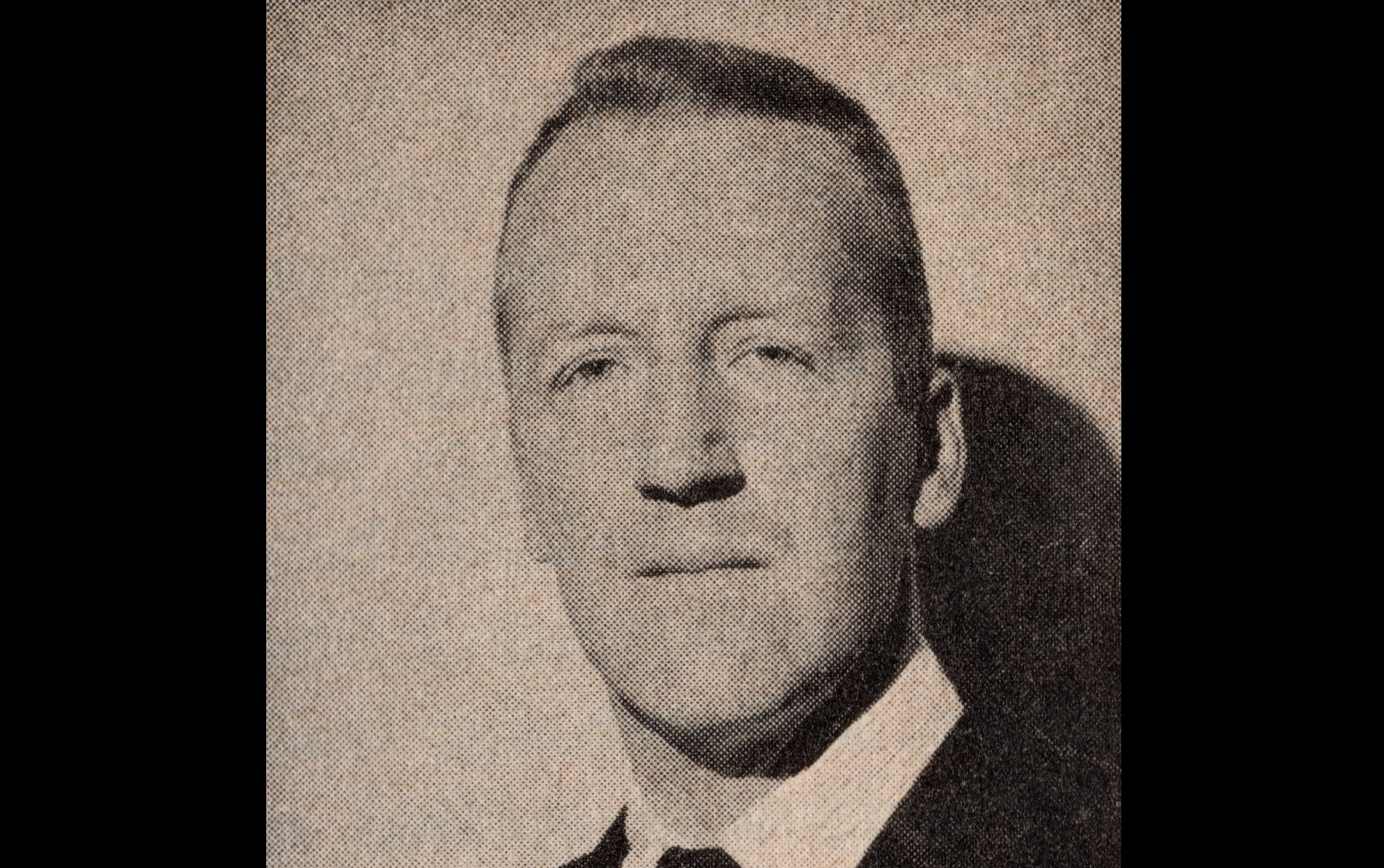
Editor’s note: We had the pleasure of speaking with Mr. Utke by phone. However, he requested the details of our conversation remain private. Therefore, all information presented here is curated from public sources and archives.
Wisconsin’s Dr. Allen R. Utke embodied interdisciplinarity throughout his career and research. Holding a Ph.D. in inorganic chemistry, Utke taught chemistry for decades at the University of Wisconsin-Oshkosh.
In his spare time, he delved into UFO research, claiming to be the only person pursuing such studies in Wisconsin at the time. Notably, Utke served as the first director of MUFON and was actively involved with the Aerial Phenomena Research Organization (APRO) and the Condon Committee. These roles placed him alongside some of ufology’s most notable figures and events. Yet, his name rarely appears in the history of the subject.
Later in life, he shifted his focus to philosophy, delving into the intersection of science and religion.
This feature will be divided into two parts. The first will cover Utke’s contributions to ufology, while the second will focus on his philosophical work.

UFO Interests
Utke researched UFOs from 1965 through 1971. He said he began researching UFOs because he felt they were a phenomenon deserving of investigation.
“If the UFOs are due to some new natural phenomenon, an answer to the controversy could lead to new scientific knowledge of inestimable value. On the other hand, if the UFOs are from outer space, our planet could stand on the verge of the greatest scientific, philosophical, and religious discoveries of all times,” he said in 1966.
He told the Oshkosh Advance Titan in 1973 that he knew the subject was worth studying after giving a local presentation on UFOs to a surprisingly large crowd.
“Normally about 30 people show up for these meetings, but that night there were about 600. After that, I wrote articles for magazines and newspapers, spoke to various groups, and went to talk to people who reported seeing UFOs,” he said.
Having decided to pursue UFO research in his spare time, he joined APRO and the National Investigations Committee On Aerial Phenomena (NICAP). Utke said he was surprised to find no one was keeping track of UFO reports in Wisconsin. Therefore, he took on the responsibility himself – telling the Oshkosh Advance Titan that he was the only person studying UFOs in Wisconsin at the time.
Utke said he had about 100 UFO reports in his file when he retired from the field, 10 or 12 concerning people who saw a UFO at close-range.
A good portion of the reports Utke investigated came from around the Durand, WI region. Durand is merely 17 miles away from Elmwood, WI, which is sometimes referred to as Wisconsin’s UFO capital after sightings came to attention there in 1976. However, Utke was investigating the area in 1966 – 10 years before Elmwood gained its notoriety.

At the time Utke was investigating the area, Elmwood would have been relatively unknown compared to Durand. According to Wikipedia, the population of Durand in 1970 was 2,103 compared to Elmwood’s 737.
Notably, the phenomena Utke investigated in the area are similar to those that put Elmwood on the map in 1976 – such as strange lights following cars. He said the UFO reports were absorbing, startling and undeniably eerie.
Utke began by investigating one case from the area, then came back to find more once word got around that he was interested in people’s stories.
“It’s amazing how people will open up once they learn you will not ridicule them if they tell their story,” Utke said.
UFO Investigations
The sighting that first got Utke’s attention from the Durand area was that of Mrs. B’s in 1966. Utke always used aliases when discussing cases to protect the privacy of the people whom he interviewed.
Mrs. B had a close-range UFO sighting at sunset. It began when she and her four children heard a loud explosion in a pasture 500 feet from their farmhouse. Looking toward the sound, they saw an oval-shaped object, 30-40 feet in diameter, hovering eight feet off the ground.

“The object was silhouetted against some distant trees,” Utke wrote. “The whole object glowed with pulsating red, green, and white lights, and it was making a high-pitched whining noise which Mrs. B said, ‘left her ears ringing.’ After remaining stationary for about 45 seconds, it titled its front edge slightly toward the ground and disappeared directly upward into the sky.”
Mrs. B told Utke she and her children believed they saw an object from outer space. She said she was, “So excited and fascinated, she couldn’t move.”
Utke added that the next day newspapers from around the area reported more accounts of people who had seen a strange object, including several policemen, from around the same time as Mrs. B.
Utke’s interest in UFOs was always people-centric. He valued interviewing eyewitnesses and made that the core of his research efforts as opposed to field investigation or landing site examinations. He said speaking directly with witnesses allowed him to determine if their reports were based on facts or fabricated.
A contributor to the University of Colorado UFO Project, better known as the Condon Committee, Utke was critical of the project as they failed to interview UFO witnesses.
“In my opinion, it was not a well-founded study. I think one of the major indications to that effect is that, to my knowledge, he [Edward Condon] never went out to interview people,” said Utke.
The strangest sighting Utke ever investigated comes from a husband and wife camping in Ogema, WI, in 1967. The pair were sleeping in their camper while visiting in-laws. Their camper was parked between the farmhouse and the milkhouse, which was attached to the barn.
At 11 p.m., the couple were awoken by the barking of their German Shepherd. Looking to see what had disturbed their dog, the couple observed a large dome-shaped object glowing with fluorescent light.
“The object was shining a beam of light to the milkhouse, which was 25 feet from us,” the couple told Utke. “The beam was sharply defined, and covered a distance of about 150 yards. It seemed to penetrate through the milk house walls, stopping abruptly at an open door. The dog had made no further sound after his initial barking and the normal night sounds stopped after the barking stopped.”
However, this silence wouldn’t last long for them.

“After what seemed to be an hour or less, we both heard the sound of a heavy person walking slowly just outside the camper. The sand and gravel on the ground made the sound distinct, and the walk was that of the type of a two-legged person,” they said.
This unnerved the couple greatly, as the door to their camper was unable to close properly and sat ajar. The husband reached for his gun and kept it trained on the door.
Though the couple heard the footsteps two more times throughout the night, no one attempted to enter their camper. Instead, who or whatever was outside seemed to be going to and from the milkhouse to the farmhouse. Each time they heard the footsteps, the couple was too frightened to move and see what was making the sound. This all lasted until dawn.
” … It was getting lighter but there was still no normal sounds. I then heard my dog whimper like a puppy about six times and then he started to bark. I’m sure he had been immobile all night. A sound like a huge generator then came from the direction of the object. But quiet or muffled. The sound faded after six to eight seconds,” the couple reported.
After the sound ended, the couple looked outside to discover everything was normal. Their dog was fine and the cows in the pasture were unfazed. As the birds began to chirp, the couple remarked it was as if nothing had happened.
Outside of tracking Wisconsin’s UFOs, Utke branched out to the larger Midwest – namely Michigan and Illinois.
Utke noticed through his research a trend in Michigan that UFOs usually appeared in late August and early September in isolated areas near iron and copper deposits. He predicted a UFO would appear in this timeframe as part of what he dubbed “Project Watch.”
Utke tried to assemble a team to go with him to stake out the location to no avail. Utke said while many were at first excited to conduct the UFO stakeout, they changed their mind after he explained they would be, “Confronting the unknown in an isolated region.”
Not wanting to go alone, Utke canceled the stakeout but received confirmation from a friend in Michigan that his prediction was correct. A UFO appeared, but it was a few hours later and 20 miles outside the exact time and location Utke forecasted. Provided one considers 20 miles and a few hours to be within the margin of error, it’s an impressive prediction by the professor.
However, it’s from Illinois that Utke would receive his most concrete UFO evidence in the form of a short film shot by Moline patrolman William Fisher. Fisher filmed the UFO on the afternoon of March 9, 1967, while on motorcycle duty.
“While on school patrol duty after lunch at Sacred Heart School in Moline, he and most of the children in the school yard noticed a bright, oval-shaped object in the sky,” Utke said. “The object was about as big as your thumb held at arm’s length when it was first seen. It gradually moved away across the sky, but not before Fisher caught it on film.”

Credit: Appleton Post-Crescent.
Fisher gave Utke a copy of the movie, who described the filmed UFO as a small spot that gradually recedes into the distance. Utke spoke with Fisher on two occasions and said he was convinced Fisher was telling the truth.
Utke added that he obtained weather information from the Midwest Central Weather Bureau and contacted the Moline airport to determine if the object was an aircraft or weather phenomenon. Utke ruled out each option, leaving him convinced it was a genuine UFO.
In his 1996 book “UFOs: A Scientific Debate,” Carl Sagan revisited the sighting and spoke with Utke about it. Sagan quotes Utke as saying he believes the UFO had something to do with the Rock Island Arsenal. However, Sagan was unimpressed by the UFO, writing, “The UFO clip is, typically, very disappointing and only shows a small oval ‘blob’ of light decreasing in size against a plain blue-sky background.”
Sagan was not the only prominent researcher and ufological figure Utke rubbed shoulders with. During his tenure studying UFOs, and as a member of APRO and NICAP, Utke was in contact with a number of interesting figures from the period.
Hynek, MUFON and Fate Magazine
Utke said he joined APRO and NICAP straight away once becoming interested in UFOs, and he’s listed as APRO’s chemistry consultant in their bulletins.
Utke’s name pops up frequently in APRO’s bulletins. A short writeup of the Moline UFO film is featured in the March-April 1967 bulletin. In the May-June 1968 bulletin, Utke’s Michigan UFO stakeout is advertised under the headline “Utke Has New Project.” The brief reads, “Those members wishing to support Dr. Allen Utke in an expedition to a repeat sighting area in August are asked to mail checks made out to him. … Dr. Utke will also accept lecture engagements to help raise funds.”
Utke’s involvement with APRO placed him at the heart of the formation of the Midwest UFO Network – today known as the Mutual UFO Network (MUFON) – and he served as the first director of MUFON.
According to MUFON’s self-written history, the formation of the organization occurred on May 31, 1969, during a meeting organized by fellow APRO member Walt Andrus. MUFON describes Andrus as organizing the meeting due to the government’s response to UFOs coupled with APRO’s ineffectual management style, writing, “Walt coordinated with a number of the affected Mid-western workers and finally concluded that it was necessary to add some grassroots structure to the organization because the sightings were happening in local areas. The only way to deal quickly and effectively was to have people ready and enabled to respond when a report came in.”

The 1969 meeting saw active investigators from Wisconsin, Illinois, Missouri, and Kansas convene. Utke was in attendance and proposed the organization of MUFON to include the states of Wisconsin, Michigan, Minnesota, Illinois, Iowa and Missouri.
As the MUFON website states:
“MUFON, then to be known as the Midwest UFO Network was born as the grass roots organization envisioned by Allen & Walt. An observer network in community areas formed the basic investigating level in MUFON. The observers reported through geographical state section directors to the State Director. The State Directors made up the Board of Directors who reported to the Midwest UFO Network Director. Dr. Utke was selected as the first MUFON Director. It was decided that MUFON would be affiliated with APRO, but not controlled by APRO.”
What’s notable about MUFON’s then framework is that it’s quite similar to the operational model Utke told newspapers was needed to solve the UFO enigma prior to MUFON’s formation.
Utke told the Appleton Post Crescent in December 1969 that it would take between $2 and $3 million a year to solve the UFO mystery. In 1972, again speaking to the Post Crescent, Utke gives the same dollar figure but elaborates that the money would be used to set up a nationwide tracking system that would section off the country and have scientists on call 24/7 with their own private air charter in order to get to the scene of UFO sightings immediately.
We can see shades of Utke’s idea in MUFON’s organizational setup, and it appears he had formulated it some time before Andrus called the meeting resulting in MUFON’s creation. Perhaps Utke used Andrus’ meeting as a springboard to launch his dream UFO task force?
It would explain why Utke was named MUFON’s director.
Utke served as the director of MUFON from May 1969 to September 1970. During his tenure, he oversaw MUFON’s first meeting on June 13, 1970, in Peoria, Ill. The theme of the conference, as suggested by Utke, was “UFOs – An Unexplored Scientific Horizon.”
Utke led off the conference with a lecture titled “UFOs and the Problem of Scientific Evidence.” Skylook, MUFON’s official publication, reported, “Dr. Utke started the day off on the right foot with a hard hitting, extremely interesting presentation that was well received by the near capacity crowd.”
The conference’s keynote speaker was Allen Hynek, who kicked off the evening session by discussing the current state of UFO research. APRO reported Hynek, “Emphasized that future progress will have to result from the efforts of civilian researchers.”
After his presentation, Hynek, Utke and other speakers held a roundtable Q&A session with the audience. The Chicago Tribune reported around 100 people attended the conference.
The MUFON conference wasn’t Utke’s first bump in with Hynek – at least not ideologically. In the October 1967 edition of Fate Magazine, Utke penned an article tackling Hynek’s infamous swamp gas explanation for a rash of UFO sightings in Michigan.

In the article “Swamp Gas, Will-O’-The-Wisp or UFOs,” Utke tackles the UFO sightings described by witnesses and goes into the science of swamp gas. Utke tackles the subject with three questions:
- Does swamp gas really exist?
- If swamp gas does exist, what is it?
- Is swamp gas a logical explanation for the Michigan UFO sightings?
Utke concludes, “Swamp gas does not seem adequate to explain the Dexter and Hillsdale sightings and does not take into account the previous sightings on March 14 and 17 in the same area. It seems to raise more questions than it answers. … Moreover, many persons who did not see the objects but who are familiar with swamp gas also question Dr. Hynek’s theory.”
Despite the criticism of Hynek, Utke and he got along well during the MUFON conference, as there are no reports of fist fights breaking out. Instead, Skylook reported, “We must declare the conference a complete success, as the speakers were well received; the news coverage was great; and as a bonus, we obtained several additional sightings from various parts of the Midwest. The conference gave us an opportunity to meet and talk with many serious investigators from over a very wide area.”
Despite the early success of MUFON under Utke’s directorship, he left the organization just a few months after the conference in September and then abandoned all of ufology in 1971.
Utke said his decision to leave ufology stemmed from a growing disillusionment with UFO studies and the direction the field was taking.
“People can’t be convinced to support you,” he said. “Scientists don’t want circumstantial evidence, but demand scientific evidence which is nearly impossible to acquire in UFO incidents, and politicians treat you skeptically.”
Utke added that as the only person in Wisconsin studying UFOs, he had tried to seek financial support from scientific groups and politicians to no luck. He added that UFO research is too difficult of a job for one person.
“It’s a thankless job and you can’t get financial support,” he stated.
Utke’s UFO Conclusions
Though he left ufology, Utke drew several conclusions and insights during his studies and investigations.
Utke did believe UFOs exist, saying that his research convinced him. He said that 60 percent of the cases he investigated pointed toward something of extraterrestrial origin, with the remainder caused by an Earthly phenomenon that science doesn’t know of.
One of the trends Utke noticed was that UFOs were most active in the spring and fall, peaking in March and August.
“One interesting factor stands out – in each case of someone seeing a UFO close by, everyone stated it looked like a machine,” noted Utke.

Utke did not, however, find UFO contactees such as George Adamski convincing, saying he believed their tales were fantasy. Yet, he did investigate a Wisconsin contactee from Neenah and said he keeps an open mind to the possibility of people meeting UFO occupants.
Utke’s greatest conclusion may well be the futility of researching UFOs. This can be felt in 1977 when he begins a lecture by jeering the audience, telling them, “Man’s a security secure seeker, probably because he’s so insecure. You’re just here because you’re interested, not because you’re concerned.”
His frustrations with the public valuing the subject as entertainment over science – and scientists not valuing it all – stems from Utke genuinely thinking UFOs worthy of serious exploration. He looked down on people who ruled out the possibility of UFOs and extraterrestrials.
“Every age of man has stated its belief that they had knowledge pretty well wrapped up, only to find that the new, the unexpected, and the ‘impossible’ was just around the corner. When a scientist today says something is ‘impossible’ he’s usually proven wrong.”
After leaving ufology, Utke would carry similar sentiments into his subsequent work, exploring the pitfalls of science and faith. This resulted in the publication of his first book, and, ultimately, the development of his religious-scientific philosophy – exploring the balance between science and faith, arguing that society’s current imbalance is leading it toward collapse.

![[Unlocked] Exploring “The Goblin Universe,” a Paranormal Classic That Holds Up](https://driftlesstimesmedia.com/wp-content/uploads/2025/08/cover-cropped.png)

Leave a Reply